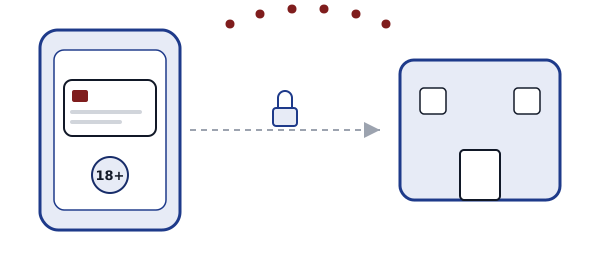
With d-you, the German implementation of the European EUDI Wallet, another building block of digital infrastructure is set to arrive in everyday life from early 2027. ID cards, driving licences and other documents are meant to become available digitally on smartphones and usable for online services too. Consumer advocates rightly insist that data protection and data minimisation be built in from the start. The Federation of German Consumer Organisations (vzbv), for instance, demands that an age check actually transmit only the necessary information – for example “over 18” – rather than automatically passing on name, address or full date of birth.12
A European solution is more than a new app
The European dimension matters especially here. The EUDI Wallet is not a purely German solo effort but part of a shared European framework for digital identities. Anyone who can identify themselves digitally in Germany in future should, in principle, also be able to use their credentials across borders within the European Union. The underlying eIDAS 2.0 regulation provides the common rules and technical standards for this.3
That is exactly where the big opportunity lies: European integration does not happen only in treaties and institutions. It becomes tangible when people experience in everyday life that Europe makes things easier. A shared digital identity can contribute to that – studying abroad as much as dealing with authorities, signing contracts or proving qualifications. At the same time, a European infrastructure strengthens Europe’s digital agency vis-à-vis the large non-European platforms.4
Taking data protection seriously – without starting from zero
The concerns raised by consumer advocates deserve attention. Identity data is among the most sensitive data there is. Data protection therefore cannot be an afterthought bolted onto d-you. At the same time, the EUDI Wallet does not enter a regulatory void. Comprehensive legal requirements for processing personal data already exist – most notably the General Data Protection Regulation, directly applicable across Europe, and the national rules that supplement it.
The EUDI Wallet itself also brings additional safeguards. Under the concept currently envisaged, identity data is stored locally and encrypted on the device. When data is shared, a complete data set is not meant to be transmitted by default either. Relying parties must register and state which information they need for which purpose.5
That does not mean further improvements are unnecessary. On the contrary: wherever tracking can be prevented, pseudonymous use enabled, or the selective disclosure of individual attributes secured more effectively through better technology, that should be implemented. Data protection and digitalisation are not opposites. Good digitalisation has to bring both together.
The barrier to entry must be low
At least as important as the question of what is technically possible, however, is the question: who can actually use the new infrastructure?
A digital identity only realises its full social benefit once it is open not just to authorities, banks and large corporations. The local sports club, the community initiative, a small business or the provider of a free digital platform should also be able to integrate the wallet in a meaningful way.
Under the European architecture framework, so-called relying parties must be registered. Member states are also expected to enable digital registration via a user interface or an API.6 That is an important starting point. It should give rise to access that is as simple, transparent and affordable for small organisations as possible.
If a small club, for instance, simply wants to confirm that a member is of legal age, that should not require a complicated certification process or hiring expensive specialist service providers. Likewise, open-source projects and providers of free services should not be effectively excluded because the technical or administrative barrier to entry is too high. A European digital infrastructure should convince precisely by also being open to the small players.
Shared standards instead of new special paths
When it comes to digital infrastructure in particular, we should also resist the temptation to create a separate German special path for every conceivable problem. The real value of the EUDI Wallet lies in shared European standards and their interoperability.
Of course, national particularities can be necessary. But they should remain the exception. Every additional special rule, every proprietary procedure and every unnecessary deviation increases complexity and cost – and ultimately makes exactly the Europe-wide use that makes the project attractive more difficult.
Europe needs digital standards that are shared not just on paper but actually work together in practice. The more easily developers, authorities, businesses and civil-society organisations can use the same interfaces and procedures, the faster a genuine European ecosystem can emerge.
Digitalisation also needs the courage to start
Germany has seen for long enough in digitalisation where the ambition to first conclusively regulate every conceivable eventuality can lead. Security, data protection and accessibility are not side issues. They have to be part of the development. But a digital infrastructure does not get better simply by staying unused for as long as possible.
With d-you, the German government is explicitly pursuing a step-by-step approach: the wallet is meant to launch with initial functions and applications in early 2027 and then be developed further. Numerous use cases are already being tested today.7
That is fundamentally a sensible path: launch, test, listen and improve. Criticism from consumer associations, data protection advocates, academia and civil society should not be seen as an obstacle here, but as part of this development process.
We need high standards. But we equally need the courage to actually deploy digital solutions. Perfection must not become a precondition for starting at all. A European digital identity can create real added value – if it is designed to be secure, open, easily accessible and genuinely European.
d-you should therefore not be the end of a development, but its beginning: a shared digital infrastructure that grows with its users and shows that Europe can not just regulate digitalisation, but also shape it.
-
RETAIL-NEWS Deutschland: d-you – digital wallet, data protection, vzbv (in German) ↩︎
-
heise online: EUDI Wallet app d-you – consumer advocates call for better data protection (in German) ↩︎
-
eudi-wallet.gov.de: Background (in German) ↩︎
-
eudi-wallet.gov.de (in German) ↩︎
-
eudi-wallet.gov.de: FAQ (in German) ↩︎
-
Bundesregierung.de: Digital Wallet (in German) ↩︎